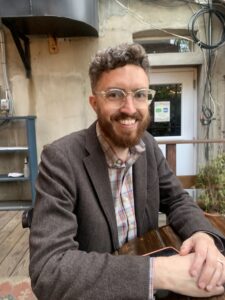
I have a sneaking suspicion that my Dad wanted to be a writer.
First of all, he’s fantastic at it. I have read letters, cards, and ephemera that my dad has scrawled in his typical caps-lock style for years, and his contributions are always witty, smart, and descriptive. This may seem like a small thing, as I thought when I was growing up – until I realized that not everyone’s Dad writes something in the card. Some dads just write their name.
Second of all, he’s told me. So I’m no Sherlock Holmes, delving into my family’s past. Shoot – Holmes never looked into his own family’s past. Who did? Nothing’s coming to mind. Maybe Poirot did, but I haven’t read any Agatha Christie. There’s Michael Bluth, I guess. But I don’t want to be Michael Bluth. I guess I’m a non-canonical Sherlock Holmes delving into my own family’s past. Dad told me he wanted to write. He wrote a couple television scripts for a class, and sometimes he tells me an idea he has for a novel that he won’t be prodded to write.
For this reason (not this reason alone, I have many shoddy reasons for wanting to be a writer) I have always wanted to write something that my Dad likes. I suppose it’s something like Dad-written-by-proxy. And I’m the proxy. Since I was a kid, I’d hand my Dad whatever I’d written, and I’d get some praise and a lot of red marks on my document, whatever it was. Here is a not-very-fair quote from an email that encapsulates this particular phenomenon: “Cute story – I just skimmed through it. A couple of typos (parents instead of parrots) and I noticed a couple of present/past tense issues.I gotta go back to work.”
When I finished writing my terrible first attempt at a novel that I wrote for my senior thesis, I remember my parents, and my Dad in particular, being the first people I wanted to read it. I even dedicated it to them. I had this fear of giving it to them, also, because I know they had just put me through college for creative writing, and my output was fine but nothing on the par of a novel. I can’t imagine what it’s like to read your son’s prose when it’s what he wants to do for a living.
I’m not a hand-wringing “My Dad never says he is proud of me” type of person. I know for a fact that my Dad is proud of me. Because he has said it on at least 4 or 5 occasions. I also feel successful in many different modes of my life, partly because my Dad is interested in what I do. But I really, really want to write a book that my Dad would love to read. Which is difficult, because I don’t really write stories that my Dad would be interested in. I think my Dad’s favorite bit of my writing is the travel blog that I kept while I was studying abroad, and I’ve always felt like that was cheating. After all, he was already invested in the main character.
Last year, inspired by some kind of madness, I asked my whole family to read Infinite Jest by David Foster Wallace with me. All 4 of us bought the book – but only my Dad and I finished. I kept expecting him to put it down. I’d send him cheerleading e-mails. I’d work progress reports into brisk conversations. When we were in the same room together, though, we talked about it for ages. The brilliance, the patience, the mind-altering prose, the mind-numbing details, the god-damned footnotes. We were frustrated together and in awe together. It was some sort of magical.
I do not write anything like David Foster Wallace. Maybe for a sentence or two, but then I go back to my particular amalgamation of Stephen King by way of Jerry Spinelli inspired by Roald Dahl (this is the equivalent of a band you formed in your friend’s garage 2 weeks ago saying your stuff is like Radiohead meets the Strokes). But I was hoping that reading Infinite Jest would make my Dad like my writing more. And that barely makes sense at all.
Here’s the gist of it. Here’s the brass tax. The type of Dad I have is the type who reads the stories I send him in emails. He’s the type of Dad who puts down what he was reading and picks up an 1,100 page book, just because his son asks him to. He’s the type of Dad who supports his son’s collegiate dream of going to school for creative writing 100 percent (not just emotionally. He paid for it. Well, both my parents did. But this is a father’s day post). I have a Dad who loves me, wants me to do what I want to do, and who talks to me about anything when I ask him to.
Happy Father’s Day, Dad. Thanks for everything you do.
P.S. Someday, I’m going to write something you love. And not just because you love me.
If you haven’t read Ender’s Game by now, and you’re someone who reads blogs from strangers for book recommendations, I’m going to assume that you’ll never read Ender’s Game. Maybe you’ve already bought it, and it’s sat on your to-be-read pile of books, gathering dust. I get that. Sometimes, a to-be-read pile of books is a frightening mountain, and I understand that choosing a modern classic anti-war novel about an 11-year-old battle expert set in a nebulous future over, say, John Irving’s new book, seems like the equivalent of choosing a Tiger Beat over the Economist. Which one will make you smarter?
Well, both. Knowledge is knowledge. Charting a pop star’s trends is a lot like following the stock market, and from what I hear, it’s good to be in the Justin Bieber business these days.
Anyway, what I’m saying is, I’m not recommending Ender’s Game.
I’m recommending the parallel novel to Ender’s Game, Ender’s Shadow.
Parallel novels are an amazing thing, as well as books that are set in the same universe as other books, yet still keeping that universe separate from our own. Stephen King is a master at this – his Dark Tower series is basically one long stick of tape that connects all of his universes together. With a book as popular as Ender’s Game, and the rest of the books in the series not as popular as the first, Orson Scott Card’s choice to write another novel set at Battle School makes tons of sense (money).
And yet, Ender’s Shadow isn’t a cash grab. The character of Bean is, to my mind, the most interesting character in the Ender Universe. Bean is incredibly intelligent, ruthless, and completely Machiavellian. If Card wasn’t set on making Bean a hero, he could have easily become the most superb of supervillains. And Ender’s Shadow is an excellent stand-alone novel, a meditation on heroism and what it means to be human. Card makes the reader feel for Bean as he watches coolly while Ender becomes lavished with glory and praise for things that Bean could have done just as easily.
I don’t know many other parallel novels off the top of my head, but I dearly, dearly wish for a parallel novel in the Harry Potter universe from Hermione’s point of view. Or Ron’s. Or both, switching chapters, watching Harry as he becomes the Chosen One, while Hermione and Ron are left to pick up the pieces of their lives when Harry isn’t around, mucking it up with ol’ Voldemort. I’m sure there’s fan fiction to this effect – but still. How busy can a billionaire be? Churn it out, Rowling.
Anyway, until that parallel novel comes out, read this one. It doesn’t have that moral, damning heft of being a modern (banned) classic. It’s just a good book.
Why the Hunger Games?
It’s no secret that dystopian/chosen-one fiction is the bread and butter of the young adult section of your local Borders. Or Barnes and Noble, I mean.
What is a secret is the recipe that Suzanne Collins used to make the Hunger Games irresistible. There are the obvious main ingredients – dystopia, self-sacrificing/chosen one heroine, life/death stakes, love triangle, teenage angst, action… but then again that’s like saying I know what’s in my grandmother’s potato souffle and only citing cheese and potatoes. There is something more in the mix, something that gets in between the joints of those ingredients. Butter, in the case of my grandmother’s potato souffle. But what’s the butter in the Hunger Games?
I only ask because the Scorpio Races doesn’t have it. It’s well-written and interesting, with the switching first person present tense perspectives that seems to be de rigeur for YA these days. It is, ultimately, the Hunger Games with horses. The stakes are nearly as high – anyone could die. The main heroes are going voluntarily, but their reasoning makes it seem like their only choice.
To go back to my butter metaphor, at the end of the book, it seems like the book is missing it. The joints aren’t oiled. There is no risk of high cholesterol. It’s more like a machine, and it adds up to exactly the sum of its parts. Maybe I’m tired of parent-less teens betting their lives on games, but I’d think that the transcendant version of Scorpio Races would make that trope unmissable.
Finding the “next big thing” in YA is like predicting where the next car crash could be. It might be at the intersection of teenage hormones and high stakes death games, since that’s where other crashes have been at the past, but that doesn’t mean that there might be a can’t-miss crash over at the intersection of sleepy small town and unwilling teenage detective. And I use a car crash metaphor because the best YA fiction has that quality of being so vital and high impact and human, but ultimately sad and without any true sense that car crashes have. At the end of a good (or even bad) YA book, you just hope everyone survives.
The Scorpio Races is neither good nor bad. But it isn’t destined to make headlines. Move along. Nothing to see here.
My childhood was filled with books.
We had family reading time even before I could read – my parents and my sister would sit quietly with books, and I would open up Calvin and Hobbes and look at the pictures. When I finally could read, I never stopped – I gobbled up whole worlds. Redwall, Hogwarts, The Boxcar (you know, the one those crime-solving children lived in.)
When I was in elementary school, I’d wake up at dawn and sit in my Mom’s lap and tell her what happened in the book I read. I think it started with Albert Payson Terhune’s Lad: A Dog, and continued on. She called it “the Lad Report.” She listened to my meandering re-tellings of the dog and his adventures, and acted like she was rapt with attention. Maybe she was.
She also wrote down the stories I told her, and encouraged me to write my own. When she read aloud, I listened – she did different voices, her face was elastic with the characters’ emotions. She handed me books that she’d read, recommended books while we were in bookstores, let me go to school on career day dressed as an author – you know, plaid button up shirt, pen in the breast pocket.
My Mom was the one who recommended Harry Potter to me. Same with Lad. And Half Magic, by Edward Eager. I would never have met Bilbo Baggins had it not been for her, or Mattimeo, or Strider, or Fudge, or Charlie or Matilda. Or, even more recently, Katniss. She supported my reading habit with weekly trips to the library, where she would browse with me. She gave me money to buy books out of the Scholastic catalog, even worked the book fair when she could.
When I was sick with a mysterious, stress/anxiety based disease which made it near impossible to eat or drink anything without serious pain, she read Old Yeller out loud. She’d even allow a flashlight in bed. Sometimes.
My Dad encouraged reading, but my Mom fueled it. She tells high school kids what to read now in her role as Canyon High’s librarian, and they better know what a treasure they have in her. She gave me life, and then she filled my life with the most meaningful thing that I do. I don’t know if she meant to create someone who wanted to be an author, but I know that she wanted to make me a reader. And she did.
Happy Mother’s Day, Mom.
A friend of mine told me he paid a rather absurd sum for a very short book. It’s out of print, an instructional manual.
The Full Facts Book of Cold Reading by Ian Rowland.
I found a copy for myself and compulsively read it when I am tired of all the other things I have to read – it doesn’t lend itself to a cover-to-cover type of treatment. The book is a how-to guide on making yourself into a tarot card reader or psychic – using talking cues and techniques to get someone to tell you about themselves, and to say things that sound like their personalities and lives.
Like horoscopes.
It’s nice to know, actually, that there is a technique. I went to a psychic once because it was “free” that day – I was walking home from the grocery store and had my palm read by a woman in her living room while children made noise in the other room. She told me a couple very vague platitudes, and let know she would get more specific for 15 dollars. I walked out feeling great that I was going to do something “creative” with my life.
Probably the most interesting thing that I have found so far in the book is Rowlands’ insistence that you can tell someone that there were life choices that they made, and they spend some time thinking about what would have happened if they chose another path. This is, of course, profoundly true. Decision making is the curse of mankind – all this damned free will that we don’t know what to do with. We are all thinking about our Robert Frost-ian selves, and wondering if that other path would have made a better kind of difference, rather than “all the difference.”
I’m not going to buy any tarot cards any time soon. Well – maybe I will, actually. But I’m not going to be opening up a psychic booth at a county fair any time soon – partly because I’m only halfway through the book, but also because I don’t know how I’d feel putting on a charlatan act of truth when I don’t know any better than the person whose palm lines I’m pretending to read. It’s nice to pretend, though.
Books are magical. They are also odd, cumbersome things that take up shelf space (but provide excellent insulation) and attract dust and silverfish (which should be prettier, considering the name). As I go down the rabbit hole, listening to podcasts (and my parents) trumpet the coming of the e-book, I clutch to my dusty, silverfished, cumbersome tomes and eye my iPad from the corner of the room, like it’s up to something.
Which it probably is.
The point is, as a book lover, it’s harder to justify buying physical copies of books sometimes. I’m a 20-something that’s constantly moving, and while a 50 cent book from the library bin is tempting, it also means I’ll throw my back out before I can even pretend to hate my 30th birthday, even though I love round numbers. So when a book comes along that you have to own in print, no question, it’s comforting. Print isn’t dead.
And, yet, I still only own this book as a PDF.
It’s because the cheapest copy I’ve found is still 200 dollars.
The Codex Seraphinianus is most likely the most bizarre and disgusting book I’ve ever “read.” I flip the pages on my iPad in mounting awe, all 250+, and I feel – something. I’m bewildered, and touched. Moved, and revolted. I’m amazed – flabbergasted. I spend about half an hour a week with it, sometimes on a certain page, sometimes just flipping back and forth.
It was published in 1981 (those first editions are about a thousand bucks), and its author, Luigi Serafini is reclusive and strange. His website leads to a blank white page. His creative output is small. But the dual volume book speaks (and doesn’t speak) for itself. The greatest description of the Codex is that it is an encyclopedia from an alternate universe – an illustrated guide to a world and life we understand is like our own and yet completely divergent. There is writing, but it is indecipherable. Serafini reportedly said, “The book creates a feeling of illiteracy which, in turn, encourages imagination, like children seeing a book: they cannot yet read it, but they realise that it must make sense.”
Sometimes, when I flip through it, I get this vague sense of purpose. I can’t be the only one who feels this way about the book, or other mysteries of the world; I feel like, sometimes, I was put on the planet for a reason. When I hear a manuscript described as “lost” or a text “indecipherable” or a treasure that’s “possibly imaginary,” I think – maybe – I am meant to be the one to find it, to decipher it, to make the treasure real. It’s a stupid notion – it passes quickly, and I can move on to re-watching another episode of Gilmore Girls.
But it’s amazing a book can make me feel this way. You can find a copy too – google it. It’s somewhere.
I love plots.
Plots are why I read books. I read books – and I realize, this might be silly – but nonetheless: I read books to be carried away, to be shown something I’ve never seen before, or think something I’ve never thought before. I like to be inside character’s heads, I like to get to know motivations, see them look at themselves in the mirror and think their thoughts and have their problems be my problems.
Great literature – the greatest literature – does all of that and then it makes it memorable. It shows you a place like you’ve never seen it, through eyes that felt familiar by the end, with characters that you love and cherish more than some family members. That is the power of good writing, good books.
Anyway, Open City is none of that. It’s New York City through eyes that don’t care, it’s fool’s gold memories shined fitfully to fool you twice, it’s philosophical conversations with the shoe shiner, the computer clerk. Teju Cole writes with repetition, like Bart on a chalk board, only with no sense of humor, and you have to read it for hours instead of mere seconds.
When you have a nothing character, it means you have a plot. When you don’t have a plot, it means you have an amazing character. When you have both plot and character, a book flies by, even if you’re reading it for weeks. When it has nothing, it’s a nothing.
While I’m glad I only borrowed this book from the library, I do wish I could give some un-inspired examples. A labored inner conversation about birds, for example. Or the bit where he has a bored conversation on a plane. But maybe I’m better off without transcribing.
I know, as I write this, that this book is intellectual and supposedly stimulating to some core group of people that like memories told through stilted walking tours of boring parts of New York City, who like things to be “real.” I know that I am coming off as anti-intellectual. I know I took this book between my covers and opened its covers and had a mind to hate it. So my review is probably worthless.
But I don’t care. I read it, I hated it, I questioned the pages it was printed on. It’s novels like this that turn impressionable adults towards the Twilights and 50 Shades of Grey in the world. Want to know why people don’t read good fiction anymore? It’s because a book like this gets lauded as a great white hope of American fiction, when it’s just labored mouthbreathing onto a mildewed page.
I’m done. Gimme something good to read.
If this were a twitter post, I would use the hashtag “#fridayreads” I suppose.
But this isn’t twitter. I imagine the millions of people who read this every few seconds armed with pitchforks and torches, shouting “We want content!”
I’m reading Angelmaker by Nick Harkaway. Harkaway has the unfortunate burden of being John le Carre’s son, but he seems to have taken up the mantle with some amount of panache.
Reading the book and spending time with it makes me wonder, though, whether or not I should be reading something more classic or literary. Harkaway deals in crooked cops and made up cults and sons of gangsters – all of which could be classic, but it doesn’t smell classic to me. I am not the type who can put down a book in the middle, so I won’t put this down, but it makes me wonder.
Fiction, what I want to write, what I write already, what I hope to contribute a book to, needs all the readers it can get. Reading only classics means reading literature that everyone has already formed an opinion on – you’re just playing catch up. No one has written a song or named a band after Nick Harkaway’s book yet, but maybe it’s just a waiting game.
Angelmaker sounds like an excellent name for a band.
There is a delicious rivalry between Young Adult novel enthusiasts (who are above the young adult age) and those that want to rip that copy of Hunger Games out of their commuter-rail grip and throw a copy of Ulysses at their stomachs. One side sees the young adult section as the answer to the failure of the post-post modern novel, the other side sees young adult readers as worthless ninnies who can’t watch half an episode of Guiding Light without getting confused.
Neither side is right. That’s why the rivalry is so excellent – they both have to continually read novels on both sides to make good points, and if people are reading, then we all win. Things Not Seen can abstain completely from the fight, because it doesn’t fall within either of these camps. Things Not Seen by Andrew Clements is MIDDLE READER, a section that might as well be a benign bookstore tumor to both the stodgy intellectuals and the teen werewolf apologists. Unless you have a young reader in your house, I can only imagine the last time you looked at a middle reader book was the last time you thought fondly back to Beverly Cleary, and her physics-defying Runaway Ralph novels.
As a middle reader novel, Things Not Seen is strange. The protagonist, for one, is 15. For two, lots of the book is devoted to a budding romance between him and a blind girl. These two factors alone make it different than your average “Ages 10 and Up” novel.
The book centers on a paranormal event in which the main character becomes invisible. The most salient point of the novel – the theme that is most interesting, and the reason I’m recommending this book to you today – is that his parents can’t help him. They are two scientists, even – and they can’t help him. Things Not Seen is based upon the very real problem that middle readers come to face – parents aren’t superheroes. They don’t have any more answers than you do, and in the blown up, metaphorical world that Andrew Clements creates, when you go invisible, you only have yourself to figure out how to become visible again.
For some reason, this book has been on my mind. It’s a classic, even though it’s only 12 years old. It beautifully illustrates something that we have all felt at one point or another, but the family remains in tact. Go and find a copy, read it in an afternoon. Then… hand it to a younger cousin.
Lauren Groff should be commended. She probably is, by many people. I know literary award functions aren’t like the Star Wars award ceremonies, but if it were up to me, I would gladly hand her that Tesla Plasma Ball that the Gungans get at the end of Episode 1.
That’s supposed to be a compliment. Here’s a straightforward compliment: Lauren Groff is a hell of a lot prettier than that Gungan king (Boss Nass. Dammit, I wish those movies were better.) What was I talking about?
Arcadia!
Arcadia, with its poetic purple prose and insistent present tense, was like being on a river rafting trip with your family, only not your family – instead, it’s the Stone family, with Bit, Hannah, and Abe. It starts idyllic, with Bit as 5 and the commune of Arcadia living in Ersatz Arcadia, a.k.a. tents. It’s pretty tense as well, as things continue. Of course. “Plot” and all that.
Sometimes, if a writer is doing his/her job right, you wish that the plot could stop right where the text is, and leave everyone well enough alone. Bit, whose shoulder we perch on for the novel, has lots of terrible things happen to him. He is born into the commune, he falls in love with a manic depressive, he has to face the stench of the real world, he is thrust into the disease-ridden future. I kept wanting his pain to end, the turmoil around him to quiet. The book is separated into 3 (maybe 4) distinct parts, and from the 1st part to the 2nd, when Arcadia’s population explodes, I could only feel despair. Once you hit the rapids, it’s all roiling uncertainty (that’s a metaphor carried over from the second paragraph).
Right on Arcadia‘s back cover, it’s compared to Lord of the Flies, and right on its inside flap, it’s said that this is a book about a commune. Neither are true. Arcadia is a book set in a commune, and while a book can be about its setting, the book is really about Bit, and how an artist’s mind and an empathetic mind are nurtured, and also torn asunder. How pain manifests itself in art, how we are forced to create the same art because of our fixations.
It’s also about Lauren Groff’s love for words and language. And the 70s, and the 80s, and the 2020s. It’s about parental love as well, and the unknowable bonds between husband and wife. I tend not to read things that criticize the things I love, and since I only read this book once, I can only give it glowing praise. It’s a delicious read. I could have read a 1200 page doorstop about the denizens of Arcadia. But present, flowing prose is hard to sustain. At 300 measly pages, I suppose I’ll have to read it 3 more times instead.